


Last Updated on April 4, 2025 by Jess Brown
Ever feel like you’re living the same day over and over again? How to get unstuck in life is something I’ve thought about countless times on my own journey. That feeling of being trapped in a loop—scrolling mindlessly, going through the motions, watching your dreams collect dust—I know it all too well.
Ten years ago, I found myself in a government job that looked great on paper. Stable income, benefits, pension—the whole security package. But inside, I felt completely hollow. I’d come home exhausted yet somehow restless, wondering if this was really all there was to life. My creative spirit was wilting, and that internal spark that makes life worth living was dimming by the day.
What I didn’t realize then was that feeling stuck isn’t a permanent state—it’s a signal that something needs to change. And that change starts with a decision that most of us are afraid to make.
1. Understanding Why We Get Stuck in Life
Before we talk about how to get unstuck, let’s be honest about why we end up there in the first place. Being stuck rarely happens overnight. It’s more like a slow drift—small compromises that pile up, dreams we put on the shelf “just for now,” comfort zones that slowly become cages.
For me, getting stuck happened while I was chasing what I thought was freedom. After leaving my government job, I built a graphic and web design business that was finally bringing in good money. I had reached my “dream” of having a lucrative online business! But as months passed, reality set in. I wasn’t enjoying the work. At all.
Every client project felt heavier than the last. The long hours, the demanding clients, the constant revisions—it wasn’t the freedom I had imagined. I found myself in a terrible position: successful by outside standards, but miserable on the inside.
“I’ve worked so hard to get here,” I’d tell myself. “I can’t just walk away now.”
That’s the trap, isn’t it? We invest so much in certain paths that changing direction feels like failure. We stay stuck because we’ve convinced ourselves it’s the only option.
The truth is, feeling stuck often comes from:
- Fear of wasting previous investments (time, money, education)
- Identity confusion (Who am I if I’m not this person I’ve been?)
- Perfectionism (I can’t move until I know exactly what to do)
- External expectations (What will others think if I change?)
- Comfort with discomfort (At least this pain is familiar)
Ever noticed how we’ll tolerate almost any amount of discomfort as long as it’s familiar? That’s why the first step to getting unstuck isn’t about taking massive action—it’s about making a decision.
Journal Prompts: Recognizing Your Stuckness
Take a moment with these questions. Don’t rush—let your honest answers emerge:
- What parts of my life feel like they’re on repeat? Where do I feel the most stuck?
- What fear comes up when I think about making a significant change?
- If I could design my ideal day without any limitations, what would it look like?
- What am I tolerating in my life right now that doesn’t align with my values?
- When was the last time I felt truly alive and engaged? What was I doing?
2. The Power of Real Decisions
The word “decision” comes from Latin, meaning “to cut off.” A real decision isn’t just a preference or a wish—it’s cutting off all other possibilities. It’s saying, “The old way is no longer an option.”
When I realized my design business was making me as miserable as my government job, I faced a difficult truth: I had to pivot again. And this time, I had to forgive myself for not getting it right the first time.
Here’s what I’ve learned about making decisions that actually stick:
- Recognize that indecision is a decision. Every day you stay in limbo is a choice for the status quo.
- Make the decision based on who you want to become, not just what you want to escape. Running away from something rarely leads to fulfillment.
- Write it down and speak it out loud. There’s power in declaring your decision—it makes it real.
- Create immediate environmental changes that support your decision. This could be as simple as rearranging your workspace or changing who you follow on social media.
When I decided to pivot from my design business, I didn’t quit overnight. That wouldn’t have been practical. Instead, I gradually phased out client work while building something new that felt more aligned. I gave myself permission to evolve and to bring forward the valuable skills I’d gained without staying trapped in a business model that didn’t serve me.
The decision wasn’t about abandoning ship—it was about charting a new course using the navigation skills I’d already developed.
Journal Prompts: Decision-Making Power
- What decision have you been avoiding that, if made, could change everything?
- What’s the cost of not making this decision? How will you feel one year from now if nothing changes?
- What strengths, skills, or knowledge will you bring forward from your current situation, even as you change direction?
- What environmental change could you make today that would support this decision?
- If your future self (who successfully made this change) could give you advice, what would they say?
3. Shifting Your Environment to Shift Your Life
Ever notice how a change of scenery can instantly change your mood? Your environment shapes your thoughts, your energy, and ultimately, your actions more than you might realize.
During the years I was building my business, I made a critical mistake. I became so obsessed with “figuring it out” that I stopped taking care of myself. I neglected healthy eating, skipped exercise, spent minimal time outdoors, and barely gave quality time to my husband.
I thought these things were luxuries I could put off until I “made it.” I couldn’t have been more wrong.
The environment I created—hunched over my computer for 12+ hours a day, fueling myself with whatever was fastest to eat, rarely moving my body—wasn’t just unhealthy. It was actively working against my goals. My creativity tanked. My motivation disappeared. My confidence plummeted. And my business suffered as a result.
When we feel stuck, we often focus entirely on changing our actions or our mindset. But sometimes, the fastest way to shift both is to change your environment first.
Simple Environment Shifts to Get Unstuck
Changing things up doesn’t necessarily mean moving to a new place (though sometimes that helps!). It can be as simple as:
- Physical environment: Decluttering your workspace, changing where you work, rearranging your living space
- Digital environment: Auditing who you follow online, setting app limits, creating phone-free zones in your home
- Social environment: Spending more time with people who energize rather than drain you
- Body environment: Changing how you fuel, move, and rest your body
When I finally recognized how my neglected physical health was affecting everything else, I made a simple commitment: 30 minutes of movement every day, no matter what. It seemed small, almost trivial compared to my “important” business goals.
Yet that one environmental change had ripple effects throughout my life and business. My thinking clarified. My energy returned. My creative blocks dissolved. And suddenly, solutions to business problems I’d been wrestling with for months appeared with surprising ease.
The 3-Day Environment Reset Challenge
Instead of a complicated challenge, I invite you to try this simple 3-day reset:
Day 1: Physical Space
Choose one space where you spend significant time. Clear every surface, clean thoroughly, and only put back items that either serve a purpose or bring you joy. Notice how this cleared space affects your thinking.
Day 2: Digital Declutter
Delete unused apps, unsubscribe from newsletters you never read, unfollow accounts that don’t inspire you, and set specific times for checking email and social media. Notice how much mental space this creates.
Day 3: Body Reset
For just one day, prioritize your physical needs above all else. Get enough sleep, drink plenty of water, eat foods that energize rather than drain you, move your body in ways that feel good, and spend at least 30 minutes outside. Notice how differently you approach problems when your body is well-cared for.
Journal Prompts: Environmental Awareness
- What in your current environment (physical, digital, social, bodily) is supporting your growth? What’s hindering it?
- What’s one space in your home that could be reorganized to better support who you’re becoming?
- How does your social media consumption affect your mood and motivation? Which accounts or platforms consistently make you feel worse?
- What’s one small change to your physical health routine that you could commit to for the next week?
- How might prioritizing rest actually accelerate your progress rather than slow it down?
4. Letting Go of Who You “Should” Be
One of the hardest parts of getting unstuck is letting go of expectations—both others and your own. When I started building my online business, very few people understood why I’d leave a stable government job with benefits to pursue something so uncertain.
Most people thought I was being irresponsible or going through some phase. They couldn’t understand why a regular paycheck and pension weren’t enough for me.
What I learned was this: People are comfortable with the version of you they know. When you start to change, it makes them uncomfortable—not because they don’t want you to succeed, but because your evolution forces them to question their own choices.
If I could make a different choice, what did that say about their decision to stay put?
The people closest to us often have the hardest time supporting our growth because they’re the most invested in who we’ve been. Their identity is partially wrapped up in their relationship with the “old you.”
This doesn’t mean you need to cut people out of your life (though sometimes creating distance is necessary). It means understanding that their resistance isn’t personal—it’s human nature.
How did I handle this? I didn’t try to convince skeptics. Instead, I found my tribe elsewhere. I connected with like-minded entrepreneurs online who understood my vision and supported my growth. These new relationships didn’t replace my existing ones—they supplemented them in areas where I needed understanding my local circle couldn’t provide.
Would you like to save this?
Unsubscribe any time and I'll never share your information.
I also learned not to over-explain my choices. The more you justify your decisions to others, the more you reinforce the idea that you need their approval. You don’t. Your life is yours to design.
Journal Prompts: Relationship Reflection
- Who in your life consistently makes you feel more capable and inspired? How could you spend more time with them?
- Who in your life tends to reinforce your doubts or limitations? How might you lovingly create boundaries?
- What story or explanation do you find yourself repeatedly giving to justify your choices? What would happen if you stopped explaining?
- What parts of your identity feel inherited rather than chosen? Which aspects of yourself have you outgrown but still cling to?
- If nobody would judge or even notice your choices, what would you do differently in your life right now?
5. Taking Imperfect Action
When I was at my most stuck, I realized something that changed everything: action precedes clarity, not the other way around.
We often think we need to feel clear and confident before we take action. But waiting for clarity before acting is like waiting to get wet before jumping in the pool—it’s backward. Clarity comes from taking action, analyzing the results, and adjusting your course.
This was especially true when I was trying to pivot from my design business. I didn’t have a perfect plan. I didn’t know exactly what would work. What I did know was that I needed to start experimenting with different possibilities—writing blog posts, creating small digital products, exploring different business models.
Some experiments failed miserably. Others showed promise. Each action, whether “successful” or not, gave me data I couldn’t have gotten any other way. And gradually, through this process of action and reflection, my path forward became clearer.
Taking Smaller Actions More Frequently is Key
Instead of waiting until you can make a perfect leap, take imperfect steps now:
- Write the imperfect first draft
- Have the awkward conversation
- Send the proposal even if it’s not perfect
- Start the workout routine even if you can only do 10 minutes
- Share your work before you feel ready
Movement creates momentum. Once you’re in motion, staying in motion becomes easier. That’s physics, but it’s also psychology.
When you’re feeling stuck, the size of the action matters less than the fact that you’re taking action at all. Even tiny steps forward can break the spell of stagnation and create momentum that builds over time.
Journal Prompts: Action Inventory
- What’s one small action (taking 15 minutes or less) that you could take today toward something you care about?
- What action have you been avoiding because you’re waiting to “feel ready”?
- If you knew you couldn’t fail, what would you try first?
- What’s something you’ve been overthinking that you could just start experimenting with instead?
- Who could you reach out to today that might offer support, insights, or opportunities related to your goals?
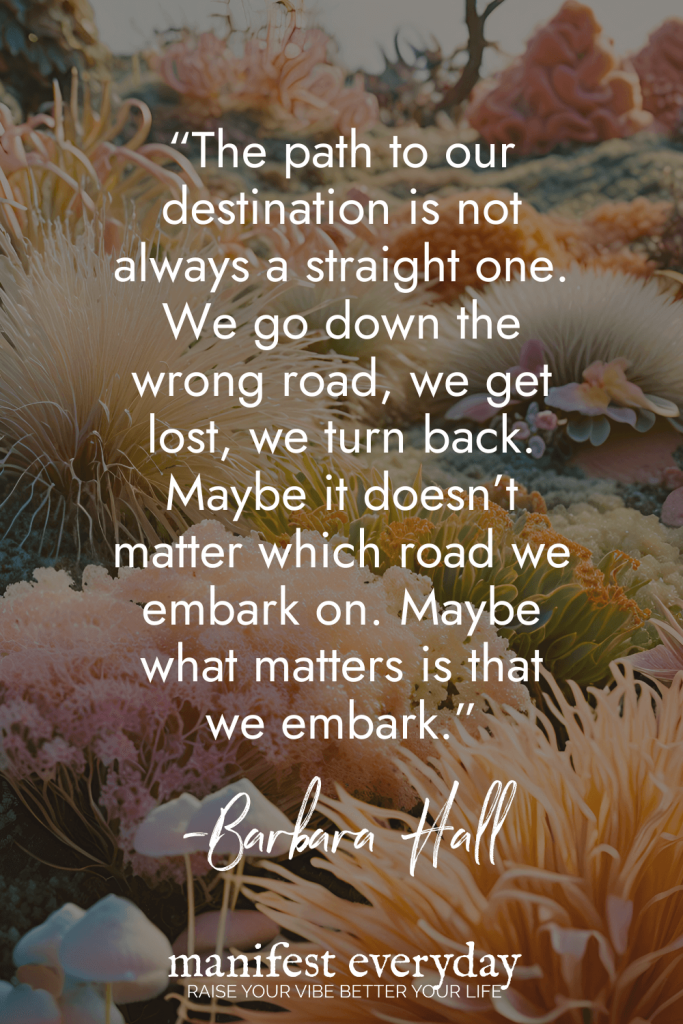
6. Building Momentum Through Consistency
When I look back at times in my life when things really started flowing for me, I notice a pattern: consistency mattered more than intensity.
It’s easy to get caught in the trap of thinking we need to make dramatic changes all at once. We attempt complete life overhauls that are impossible to maintain, burn out quickly, and end up more discouraged than when we started.
I’ve found that small, consistent actions create a compound effect that massive, sporadic efforts never achieve. When I was building my current business, what ultimately moved the needle wasn’t occasional 14-hour workdays—it was showing up consistently, day after day, even when I didn’t feel like it.
Streak systems have been incredibly powerful for me—tracking consecutive days of completing key habits. There’s something deeply motivating about not wanting to break a streak. I’ve used this for everything from daily walking to content creation to gratitude practices.
What I love about streaks is how they build both confidence and evidence at the same time. Each day you follow through on your commitment is a small vote for your new identity. You’re not just doing the thing; you’re becoming the kind of person who does the thing. That shift in identity is what ultimately breaks you free from feeling stuck.
The key is to make your daily commitments small enough that you can maintain them even on your worst days. It’s better to meditate for five minutes every day than for an hour once a week. It’s better to write 300 words daily than to attempt a 5,000-word article once a month.
When you’re consistent with small actions, three powerful things happen:
- Your identity starts to shift (“I am becoming someone who…”)
- You gather real-world data about what works and what doesn’t
- You build momentum that makes larger actions feel more accessible
Journal Prompts: Consistency Building
- What’s one key habit that, if performed consistently, would move you toward your goals?
- How could you make this habit so small that it would be nearly impossible to fail at it?
- What would help you track and celebrate your consistency streak?
- What time of day could you anchor this habit to, connecting it to something you already do consistently?
- How might you plan ahead for obstacles that typically derail your consistency?
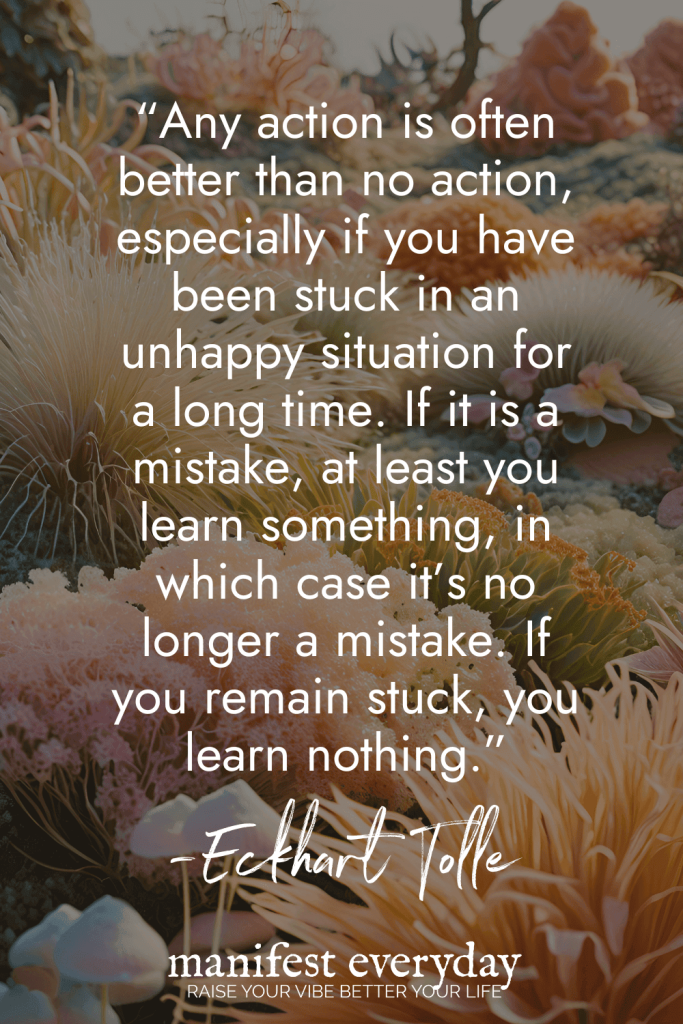
7. Celebrating Progress (Even When It’s Messy)
One of the biggest mistakes I made when trying to get unstuck was focusing exclusively on the gap between where I was and where I wanted to be. That gap always seemed enormous, and staring at it only made me feel worse.
What changed everything was learning to celebrate progress along the way—not just major milestones, but tiny victories too. This isn’t about participation trophies; it’s about recognizing that change is a process, not an event.
When I started prioritizing my health alongside my business, I didn’t wait until I’d lost a certain amount of weight or reached a specific fitness goal to feel good about my efforts. I celebrated the day I first chose a walk over scrolling social media. I celebrated when I meal-prepped for the first time. I celebrated when I drank enough water for three days straight.
These small celebrations served a crucial purpose: they kept me engaged in the process long enough to see meaningful results. Because let’s be honest—meaningful change takes time. If we can’t find joy in the messy middle, we’ll never reach our destination.
Celebration doesn’t have to be elaborate. Sometimes it’s as simple as acknowledging your progress: “I showed up today when I didn’t feel like it. That’s growth.” Or “I noticed that old pattern starting and chose differently this time. That’s progress.”
By celebrating small wins, you train your brain to notice what’s working rather than just what’s missing. This positive reinforcement makes it easier to stay motivated and consistent—which, as we’ve discussed, is what ultimately creates breakthroughs.
Journal Prompts: Progress Recognition
- What small steps have you already taken toward getting unstuck that deserve acknowledgment?
- What “failure” have you experienced that actually taught you something valuable?
- In what ways are you different now compared to six months ago that indicate growth?
- What’s one area where you’re being too hard on yourself about your progress?
- How could you build small celebrations into your daily or weekly routine?
How to Get Unstuck in Life: Bringing It All Together
Getting unstuck isn’t a one-time event; it’s a practice. Some days you’ll feel the flow and momentum. Other days you’ll feel resistance and doubt creeping back in. That’s not failure—it’s being human.
The key is developing awareness of when you’re slipping back into old patterns and having strategies ready to shift your state. Here’s a simple framework I use whenever I find myself feeling stuck again:
- Pause and acknowledge where you are without judgment. Getting unstuck starts with honest awareness.
- Revisit your decision. Have you been fully committed, or has your decision been half-hearted? Recommit clearly to what you want.
- Change one element of your environment immediately. This could be physical, digital, social, or bodily.
- Take one imperfect action, no matter how small. Focus on movement, not perfection.
- Connect with someone who believes in your potential. Sometimes we need external perspective when we can’t see clearly.
- Track and celebrate any progress, no matter how tiny. Evolution happens in small increments.
- Stay consistent with your key habits, especially when you don’t feel like it. This is often when the biggest breakthroughs happen.
Getting unstuck is rarely a linear process. You’ll have days of flow and days of struggle. What matters is your commitment to the journey and your willingness to keep taking those small, consistent steps forward.
And maybe most importantly, be gentle with yourself along the way. Getting unstuck isn’t about forcing yourself into some idealized version of productivity and success. It’s about reconnecting with what truly matters to you and aligning your life accordingly.
Even More Reading On This Topic:
- 7 Easy Steps to Get Unstuck and Manifest What You Want
- Quotes for Difficult Times: Why Some Transform Us While Others Fall Flat
- 65 Deep Journal Prompts to Get Unstuck & Gain Clarity
Frequently Asked Questions About Getting Unstuck
Feeling stuck often has less to do with your external circumstances and more to do with alignment between your actions and your values. You can have a perfectly “good” life on paper while feeling deeply unfulfilled if you’re not living in alignment with what truly matters to you.
This is exactly what happened to me in my government job. It was stable, paid well, had great benefits—but it didn’t align with my need for creativity, autonomy, and making a more direct impact. There was nothing “wrong” with the job; it just wasn’t right for me.
Take some time to reflect on your core values and whether your daily life allows you to express them. Often, the feeling of stuckness is your inner wisdom trying to tell you something important about what you truly need.
Not knowing your exact destination is one of the most common reasons people stay stuck. Here’s the truth: you don’t need complete clarity to start moving. In fact, clarity often comes from action, not the other way around.
Start by identifying what you know you don’t want. This helps narrow the field. Then, rather than trying to find your one true passion, experiment with small, low-commitment actions in different directions. Take a class, volunteer, shadow someone in a field you’re curious about, start a tiny side project.
Think of it as collecting data rather than making a final decision. Each experience will give you information about what energizes you, what drains you, what you’re naturally good at, and what values are most important to you.
During my transition, I tried several different business models before finding what worked. Each “failed” experiment was actually valuable data that led me closer to the right path.
This is where tracking and celebrating small wins becomes really important. Our brains are wired to focus on what’s not working, which can make progress feel nonexistent even when it’s happening.
I keep a simple “evidence journal” where I write down one small win each day. When motivation wanes, I can look back and see concrete evidence of how far I’ve come, even if it feels like I’m standing still.
Also, make sure your measurement of progress is appropriate. We often set the bar too high, looking for dramatic transformation when the real change happens incrementally. Sometimes progress looks like being a little less reactive to stress, saying no to something that doesn’t serve you, or simply showing up for your practice when you don’t feel like it.
Finally, remember that motivation naturally fluctuates. The most successful people aren’t always motivated; they’re committed. They’ve built systems and habits that carry them through periods of low motivation.
Financial constraints are real, and it’s important to acknowledge them without using them as a reason to remain permanently stuck. Here’s my approach: look for the smallest possible step you can take that doesn’t require significant financial resources.
When I wanted to leave my government job, I couldn’t just quit without another source of income. So I started building my business on the side, working mornings before my day job, and/or after work and weekends. It wasn’t easy, but it was possible.
If your dream requires education or training you can’t currently afford, look for free or low-cost learning opportunities online. If you want to change careers but need your current income, look for ways to gain relevant experience through volunteering or side projects.
The key is to start where you are with what you have. Even small movements in your desired direction will create momentum that can eventually lead to bigger opportunities.
Fear of making the wrong choice keeps countless people stuck in situations they’ve outgrown. I’ve felt this intensely, especially when I was considering pivoting away from my design business after investing so much in building it.
Here’s what helps me: First, recognize that there are very few truly irreversible decisions. Most changes can be adjusted or even reversed if needed.
Second, reframe how you think about “wrong” choices. Every choice gives you data and experience that informs your next move. Even choices that don’t work out as planned teach you something valuable about yourself and what you need.
Finally, consider what you’ll regret more—trying something new that might not work out, or never trying at all. In my experience, the pain of wondering “what if” far exceeds the discomfort of trying something that doesn’t work out as planned.
Your Next Steps to Get Unstuck in Life
Now that we’ve explored these strategies for getting unstuck, it’s time to put them into action. Here’s what I suggest:
- Choose just one idea from this post that resonated most strongly with you.
- Commit to implementing it for the next seven days, no matter what. Make it small enough that success is nearly guaranteed.
- Track your progress daily, noting any shifts in your energy, mood, or perspective.
- After seven days, reflect on what you’ve learned and choose your next step.
This isn’t about overhauling your entire life overnight. It’s about making small, consistent shifts that gradually create momentum in a new direction.
I’d love to hear which strategy you’re going to implement first and how it goes for you. Share in the comments below or reach out directly—I’m always inspired by hearing about your journeys.
NOW OVER TO YOU: What’s one small step you’ll take today to get unstuck in life? Sometimes just declaring your intention publicly can be powerful momentum.
Did you find this post useful or motivating? Save THIS POST below to your PERSONAL GROWTH board on Pinterest. 🙂